

As a supplier of home fresh air exchangers, I've witnessed firsthand the growing demand for these systems in modern households. One of the key concerns for many customers is noise reduction. A quiet fresh air exchanger ensures a peaceful living environment without disturbing the daily activities or sleep of the occupants. In this blog, I'll explore the various noise reduction technologies employed in home fresh air exchangers.
1. Sound - Absorbing Materials
One of the most fundamental ways to reduce noise in a home fresh air exchanger is by using sound - absorbing materials. These materials work by converting sound energy into heat energy, thus reducing the amount of sound that is transmitted through the exchanger's structure.
- Insulation Foam: High - density insulation foam is commonly used inside the casing of the fresh air exchanger. This foam can effectively absorb and dampen the sound generated by the internal components, such as the fan and the motor. For example, some of our products use a special type of insulation foam that has a high noise reduction coefficient (NRC). The NRC measures how well a material absorbs sound, with a value of 1 indicating perfect absorption. Our foam typically has an NRC of around 0.8, which means it can absorb 80% of the sound that hits it.
- Acoustic Panels: Acoustic panels are another effective sound - absorbing solution. These panels are often made of materials like fiberglass or mineral wool and are designed to be installed on the inner walls of the exchanger. They can be customized in terms of thickness and density to achieve the desired level of noise reduction. Some of our high - end models feature acoustic panels that are specifically engineered to target the frequencies commonly generated by the fresh air exchanger, providing optimal noise reduction.
2. Fan Design and Placement
The fan is one of the main sources of noise in a home fresh air exchanger. Therefore, careful design and placement of the fan can significantly reduce the noise level.

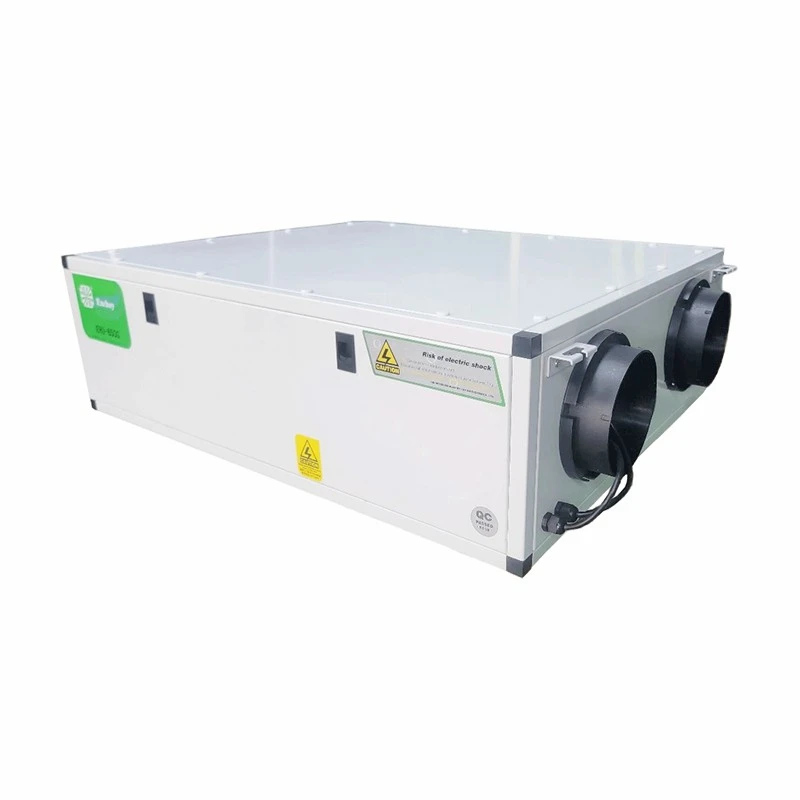
- Aerodynamic Fan Blades: Modern fresh air exchangers are often equipped with aerodynamic fan blades. These blades are designed to move air more efficiently, reducing turbulence and the associated noise. The shape of the blades is optimized to minimize the pressure fluctuations that can cause noise. For instance, some of our fans have a backward - curved blade design, which not only improves the airflow but also reduces the noise generated by the fan.
- Fan Placement: The placement of the fan within the exchanger is also crucial. By isolating the fan from the main body of the exchanger and using vibration - damping mounts, the noise transmission can be reduced. We often place the fan in a separate chamber with sound - absorbing materials around it. This helps to contain the noise generated by the fan and prevent it from spreading throughout the exchanger.
3. Motor Technology
The motor is another significant source of noise in a fresh air exchanger. Advanced motor technologies can help to reduce the noise level.
- Brushless DC Motors: Brushless DC motors are becoming increasingly popular in home fresh air exchangers. These motors have several advantages over traditional brushed motors. They are more energy - efficient, have a longer lifespan, and produce less noise. The absence of brushes in a brushless DC motor reduces the mechanical friction and electrical arcing, which are major sources of noise in brushed motors. Our latest models are equipped with high - quality brushless DC motors that operate quietly while providing sufficient power to drive the fan.
- Variable - Speed Motors: Variable - speed motors allow the fresh air exchanger to adjust the fan speed according to the ventilation requirements. By running the motor at a lower speed when the ventilation demand is low, the noise level can be significantly reduced. For example, during the night when the occupants are sleeping, the motor can operate at a slower speed, providing a quiet and comfortable environment.
4. Duct Design and Installation
The ducts used in a home fresh air exchanger can also contribute to the noise level. Proper duct design and installation are essential for noise reduction.
- Smooth - Walled Ducts: Smooth - walled ducts are preferred over rough - walled ones as they reduce the friction between the air and the duct walls, minimizing the noise generated by the airflow. We recommend using ducts made of materials like PVC or aluminum, which have smooth inner surfaces. Additionally, the ducts should be properly sized to ensure that the air flows smoothly without creating excessive turbulence.
- Duct Insulation: Insulating the ducts can further reduce the noise transmission. Similar to the insulation used in the exchanger casing, duct insulation can absorb the sound waves traveling through the ducts. We offer duct insulation options that are specifically designed for fresh air exchanger systems, providing an additional layer of noise reduction.
5. Vibration Isolation
Vibration is another factor that can contribute to the noise level in a home fresh air exchanger. By isolating the vibrating components from the surrounding structure, the noise generated by vibration can be reduced.
- Rubber Mounts: Rubber mounts are commonly used to isolate the motor and the fan from the exchanger's frame. These mounts absorb the vibrations generated by the rotating components and prevent them from being transmitted to the rest of the exchanger. Our products use high - quality rubber mounts that are designed to provide maximum vibration isolation while maintaining the stability of the components.
- Anti - Vibration Pads: Anti - vibration pads can also be used under the exchanger to isolate it from the floor or the mounting surface. These pads are made of materials like neoprene or silicone and can effectively reduce the vibration transmission to the building structure.
How Our Products Incorporate These Technologies
At our company, we are committed to providing high - quality home fresh air exchangers with excellent noise reduction performance. Our products are designed to incorporate all the above - mentioned noise reduction technologies.
For example, our Ceiling Foaming Machine uses high - density insulation foam and acoustic panels to absorb the sound generated by the internal components. The fan is equipped with aerodynamic blades and is placed in a separate chamber with vibration - damping mounts. The motor is a variable - speed brushless DC motor, which operates quietly and efficiently.
Our Home Energy Recovery Ventilator features a carefully designed duct system with smooth - walled ducts and duct insulation. The exchanger is also installed with rubber mounts and anti - vibration pads to minimize the vibration - related noise.
Similarly, our Fresh Air Heat Exchanger combines all the noise reduction technologies to provide a quiet and comfortable fresh air solution for your home.
Conclusion
Noise reduction is an important aspect of home fresh air exchanger design. By using sound - absorbing materials, optimizing fan and motor design, paying attention to duct design and installation, and implementing vibration isolation techniques, we can significantly reduce the noise level of the fresh air exchanger. At our company, we are dedicated to providing our customers with high - quality products that not only improve the indoor air quality but also ensure a quiet living environment.
If you are interested in our home fresh air exchangers or have any questions about noise reduction technologies, please feel free to contact us for a detailed discussion and to start the procurement process. We look forward to working with you to create a healthier and quieter home environment.
References
- "Noise Control Engineering: Principles and Applications" by Clarence E. Bies and Colin H. Hansen.
- "Handbook of Noise and Vibration Control" edited by Malcolm J. Crocker.
- Industry reports on fresh air exchanger technology and noise reduction trends.