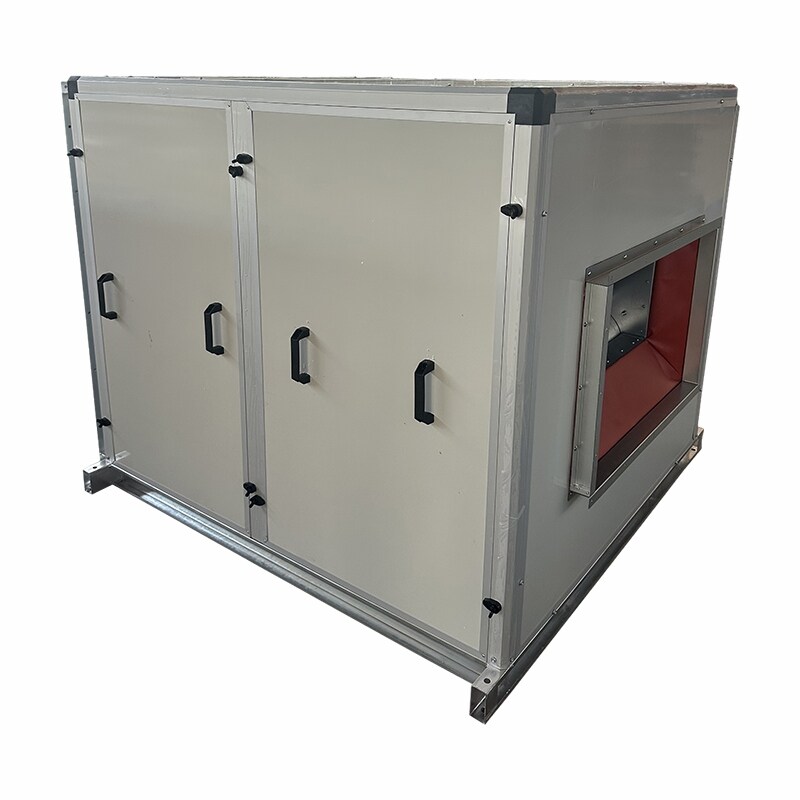
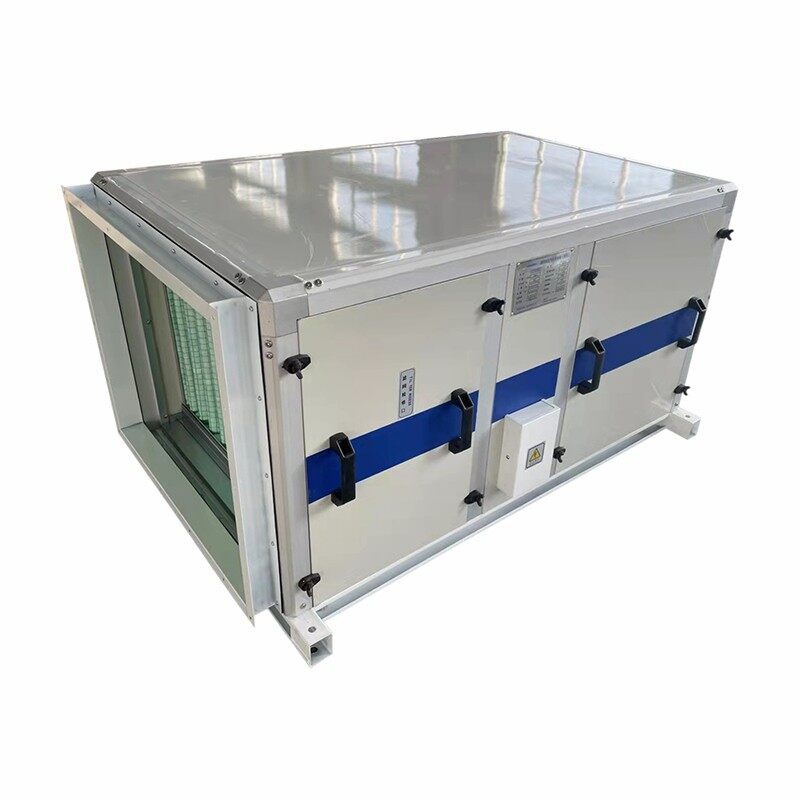
45mm inclined angle frame; 30mm/50mm color steel plate; backward-curved fan; high efficiency for 35,000-60,000m³/h with a V-shaped design.
Extension of length by adding high-efficiency equipment: 12,000-15,000m³/h: +200mm; 18,000m³/h: +300mm; 20,000-30,000m³/h: +400mm; 40,000-60,000m³/h: +650mm.
This product adopts a backward-curved fan and high-quality motor. It features large air volume, high air pressure, stable operation, and low noise. The cabinet is easy to assemble and maintain, making installation and servicing simple.
Customers can choose materials based on specific site requirements. The standard configuration uses double-sided color steel with a polystyrene core panel in the middle. This material offers thermal insulation, waterproofing, and a certain level of fire resistance. The frame is made of inclined aluminum profiles, which are aesthetically pleasing and corrosion-resistant.
Additionally, different grades of filtration devices can be selected based on the environment, achieving the purpose of air purification.

|
Model |
Air quantity (m³/h) |
Dimensions (mm) |
Power (Kw) |
Static Pressure (Pa) |
Air Intake (mm) |
Air Outlet (mm) |
Voltage (V) |
|
2.5# |
2000 |
1600*800*710 |
1.1 |
650 |
710*575 |
450*450 |
380 |
|
2.8# |
3000 |
1700*800*710 |
2.2 |
650 |
710*575 |
500*500 |
380 |
|
3.15# |
4000 |
1750*800*795 |
3 |
700 |
710*660 |
500*500 |
380 |
|
3.15# |
5000 |
1750*900*895 |
4 |
800 |
810*760 |
550*550 |
380 |
|
3.55# |
6000 |
1800*1000*950 |
4 |
800 |
910*815 |
600*600 |
380 |
|
3.55# |
7000 |
1800*1000*950 |
5.5 |
800 |
910*815 |
600*600 |
380 |
|
4# |
8000 |
1950*1095*1050 |
7.5 |
800 |
1005*915 |
650*650 |
380 |
|
4# |
10000 |
1950*1195*1110 |
7.5 |
800 |
1105*975 |
650*650 |
380 |
|
4.5# |
12000 |
2200*1295*1110 |
11 |
800 |
1205*975 |
700*700 |
380 |
|
5# |
15000 |
2400*1295*1330 |
11 |
800 |
1209*1175 |
800*800 |
380 |
|
5# |
18000 |
2800*1600*1330 |
15 |
800 |
1510*600 |
800*800 |
380 |
|
5.6# |
20000 |
2900*1600*1450 |
15 |
800 |
1510*800 |
900*900 |
380 |
|
5.6# |
22000 |
2900*1600*1550 |
18.5 |
800 |
1510*800 |
900*900 |
380 |
|
6.3# |
25000 |
3000*1800*1650 |
18.5 |
800 |
1710*900 |
1000*900 |
380 |
|
6.3# |
27000 |
3000*1800*1650 |
18.5 |
800 |
1710*900 |
1000*900 |
380 |
|
7.1# |
30000 |
3200*1900*1800 |
22 |
800 |
1810*1050 |
1050*1050 |
380 |
|
7.1# |
35000 |
3200*2000*1950 |
30 |
800 |
1910*1100 |
1100*1100 |
380 |
|
8# |
40000 |
3000*2100*2150 |
37 |
800 |
1960*1100 |
1200*1100 |
380 |
|
8# |
45000 |
3000*2300*2250 |
37 |
800 |
2060*1100 |
1200*1100 |
380 |
|
9# |
50000 |
3400*2600*2300 |
37 |
800 |
2460*1200 |
1250*1200 |
380 |
|
9# |
60000 |
3400*2800*2400 |
45 |
800 |
2660*1200 |
1250*1200 |
380 |
General Fan Facts Description
• The fan is used for transportation of "clean"air, meaning not intended for fire-dangerous substances, explosives, grinding dust, soot, etc.
• The fan is equipped with an asynchronous external rotor induction motor with maintenance-free sealed ball-bearings.
• The capacitor has finite lifetime and should be exchanged after 45,000 hours of opera-tion (about 5 years) to secure maximum function. Defective capacitor can cause damage.
• To achieve maximum life time for installations in damp or cold environments, the fan should be operating continuously.
• The fan can be installed outside or in other damp environments. Make sure that the fan-house is equipped with drainage.
• The fan can be installed in any position.
Installation
• The fan must be installed according to the air direction label on the fan.
• The fan must be connected to duct or equipped with a safety grille.
• The fan should be installed in a safe way and make sure that no foreign objects are left behind.
• The fan should be installed in a way that makes service and maintenance easy.
• The fan should be installed in a way that vibrations can not be transfused to duct or building.
• To regulate the speed, a transformer, a triac or a frequency converter can be connected.
• A wiring diagram is applied on the inside of the junction box or separately enclosed.
• The fan must be installed and connected electrically in the correct way grounded.
• Always use the internal thermocontact, see wiring diagram.
• Electrical installations must be made by an authorized electrician.
• Electrical installations must be connected to a locally situated tension free switcher or by a lockable head switcher.
Operation
When starting, make sure that:
• The current does not exceed more than +5% of what is stated on the label.
• The connecting voltage is in between +6% to –10% of the rated voltage.
• No noise appears when starting the fan.
• The rotation direction at 3-phase motors are according to the label.
How To Handle
• The fan must be transported in its packing until installation.This prevents transport damages, scratches and the fan from getting dirty.
• Attention, look out for sharp edges and corners.
Maintenance
• Before service, maintenance or repair begins, the fan must be tension free and the impeller must have stopped.
• Consider the weight of the fan when removing or opening larger fans to avoid jamming and contusions.
• The fan must be cleaned when needed, at least once per year to maintain the capacity and to avoid, unbalance which may cause unnecessary damages on the bearings.
• The fan bearings are maintenance-free and should be renewed only when necessary.
• When cleaning the fan, high-pressure cleaning or strong dissolvent must not be used.
• Cleaning should be done without dislodging or damaging the impeller.
• Make sure that there is no noise from the fan.
Fault Detection
1. Make sure that there is tension to the fan.
2. Cut the tension and verify that the impeller is not blocked.
3. Check the thermocontact/motor protector. If it is disconnected the cause of overheating must be taken care of, not to be repeated. To restore the manual thermo-protector the tension will be cut for a couple of minutes. Larger motors than 1.6A may have manual resetting on the motor. If it has automatic thermo-protector the resetting will be done automatically when the motor is cold.
4. Make sure that the capacitor is connected, (single phase only) according to the wiring diagram.
5. If the fan still does not work, the first thing to do is to renew the capacitor.
6. If nothing of this works, contact your fan supplier.
7. If the fan is returned to the supplier, it must be cleaned, the motor cable undamaged and a detailed nonconformity report enclosed.
Warranty
The warranty is only valid under condition that the fan is used according to this "Directions foruse".
Pressure / Flow-curves Explanation

FIG. 1:
The fan curve describes the capacity of the fan, i.e. the flow of the fan at different pressures at acertain input voltage.
The fan diagram has the pressure in Pascal, Pa, on the vertical axis and the flow in cubic metres per second, m3/s, on the horizontal axis.
The point on the fan curve showing the current pressure and flow is called the fans working point. In our example it is marked with P.
If the pressure increases in the ducts, the working point moves along the fan curve and hence a lower flow is obtained. In the example the working point would move.

FIG. 2:
The system line describes the total behaviour of a ventilation system (ducts, silencers and valvesetc.).
Along this system line, S, the working pointis moved from P2 to P3 as the rotational speedis changed.
Distinct voltage steps with eg. a transformer produces different fan curves, 135 V and230 V, indicated in the example.

FIG. 3:
Our fan curves present the total pressure in Pascal. Total pressure = Static + Dynamic pres-sure.
The static pressure is the pressure of the fan compared to the atmospheric pressure. It is this pressure that shall overcome the pressure losses of the ventilation system.
The dynamic pressure is a calculated pressure that arises at the outlet of the fan, and ismostly due to air velocity. The dynamic pressure thus describes how the fan is working. The dynamic pressure is presented with a curve, starting at origo, that increases with increased flow. A high dynamic pressure can with wrong duct connection produce a high pressure loss. If the pressure loss in the system is known, a fan whose difference between the total and the dynamic pressure corresponds to the pressure loss in the system must be found.
Sound Data Explanation
Sound data in this brochure is based on following definitions: in the system must be found.
The points for which the sound data is presented are along the system line defined by the pressure and flow stated in the sound data tablefor each fan. There are three types of sound in these tables; inlet and outlet sound are measured in duct, while the surrounding sound is measured outside the fan and duct system. For all these types of sound, the sound power levels are presented in octave bands. For the surrounding sound, also the sound pressure level has been calculated. Measurements are made according to ISO 3741 for surrounding sound or ISO 5136 for sound measured to duct.
Sound measurements at Enchoy are made according to ISO-standards and with the fans in their housings because this is close to reality values.
ISO-method: Measurement is made in duct with specified design and non-reflecting connection. Measurements and calculations are made in 1/1 octave band.
Measurements of the fan without it's housing resolves in lower sound. The trade association ASHRAE in USA, is stated in Application of Manufacturers Sound Data, that the result of sound measure ments of a fan without it`s housing is 5-10 dB lower in octave bands from 250 Hz and lower than a fan in it's housing.
AMCA-method: Measurement is made of the fan with out it's housing in an anechoic room, which results in lower sound level.
Accuracy Of Measurement
When developing the measurement method for the sound power level to duct, the International Standards Organisation, ISO, also analysed the inaccuracy of measurement in different octave band (90% accuracy).
| Octave band (HZ) | 63 | 125 | 250 | 500 |
| Inaccuracy (dB) | ±5.0 | ±3.4 | ±2.6 | ±2.6 |
| Octave band (Hz) | 1000 | 2000 | 4000 | 8000 |
| Inaccuracy (dB) | ±2.6 | ±2.9 | ±3.6 | ±5.0 |
The Sound Power Level
The sound power level, Lw(A) is used to calculate the sound from the whole ventilation system. This system can be a composition of grilles, dampers and diffusers for example.
The sound power level is a measured value according to standards, and it does not tell how the sound appears as the sound power is independent of the characteristics of the placement of the fan. In order to resemble the human ear, the A-filter is used indicated with Lw(A) measured in dB(A) measure in dB(A).
The Sound Pressure Level
The sound pressure level, Lp or Lp(A), tells how the human ear registers the sound. It is dependent on the sound power level, distance from the source, restrictions of the propagation and the acoustic characteristics of the room.
The sound pressure level is presented for a room with an room with an equivalent absorption area of 20m2. 7dB difference correspond to a distance of ca 3m, where the sound is emitted in a semispherical propagation.
The sound pressure level can be calculated as: LP=Lw+10log (Q/4τr2+4/A)
A=is the room's equivalent absorption area Q=is the propagation type:
Q=1 is spherical propagation
Q=2 is semi spherical propagation
Q=4 is quarter spherical propagation
For the free field case, I.e. from a roof fan, the sound pressure level is calulated as: Lp=Lw+10logQ/4τr2.
With Lw(A) tot at 63dB(A), a distance of 5 meters, semi spherica propagation and free field case, the result will be Lp(A)=63+10log2/4τ 52=63-22=41dB(A)
And at 10 meters: Lp(A)=63+10log2/4τ 102=63-28=35dB(A)
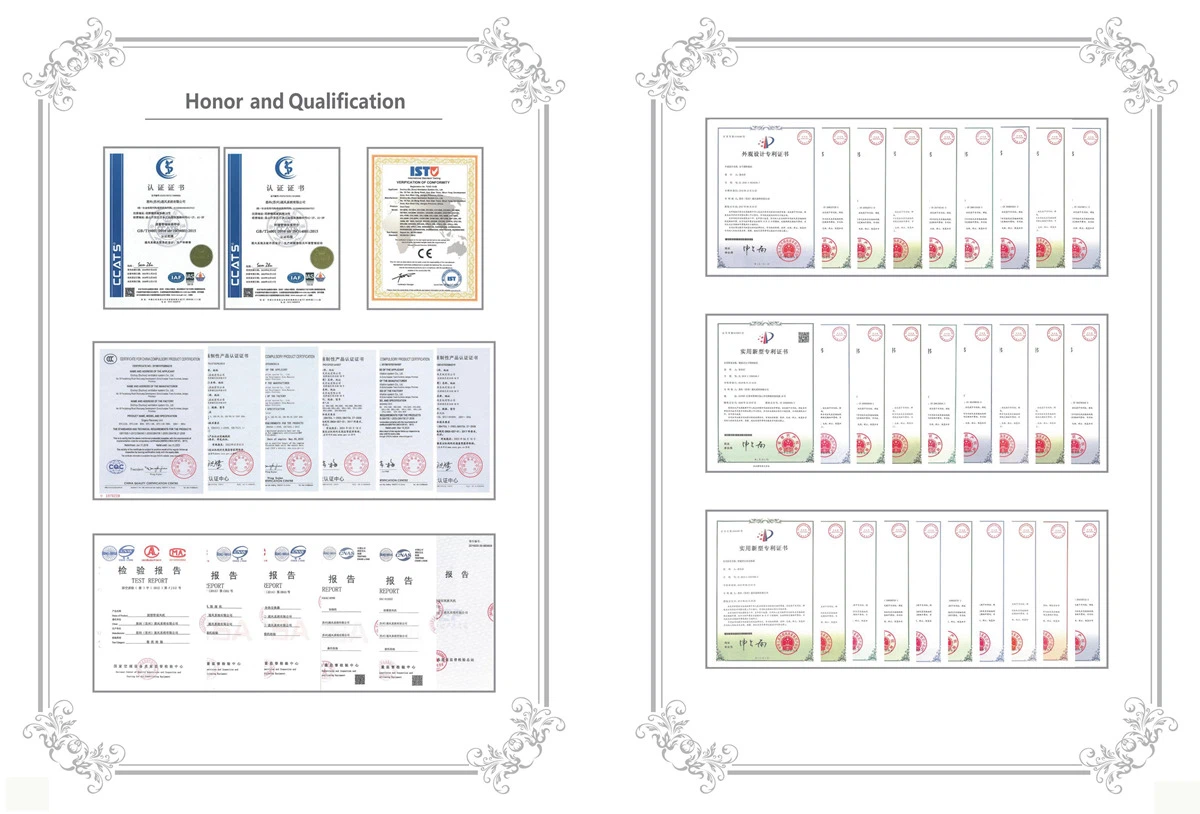
Our Certificate